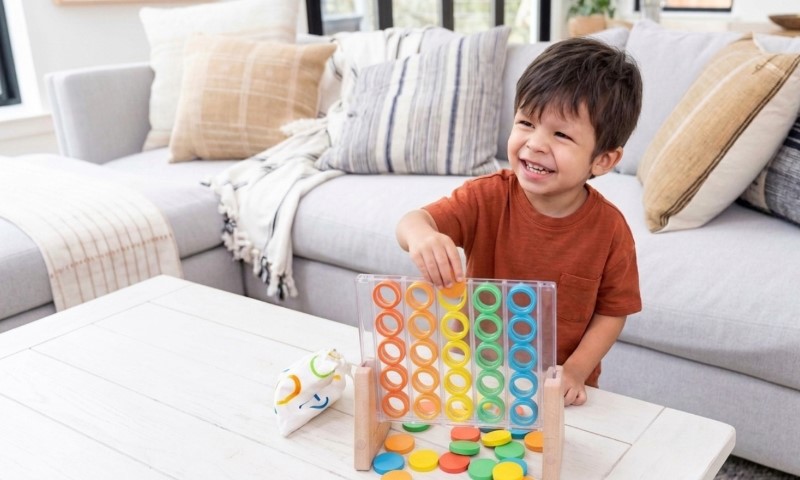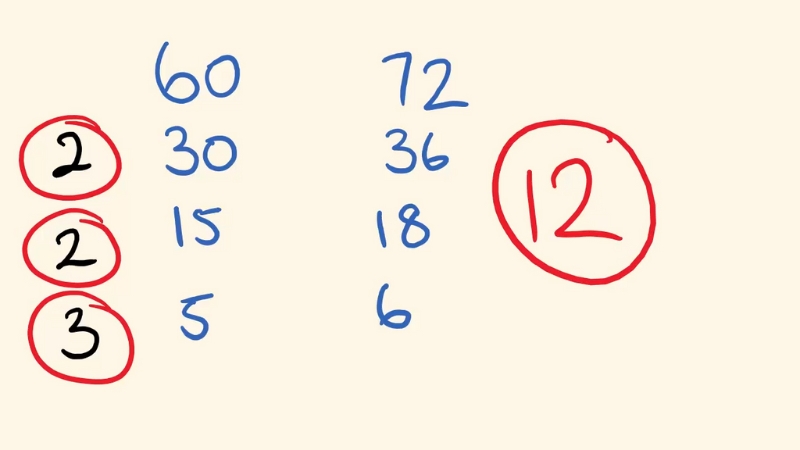

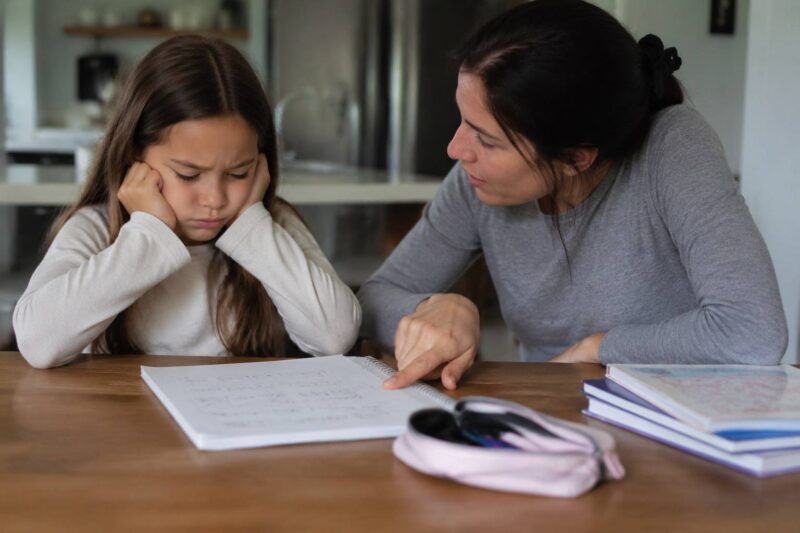
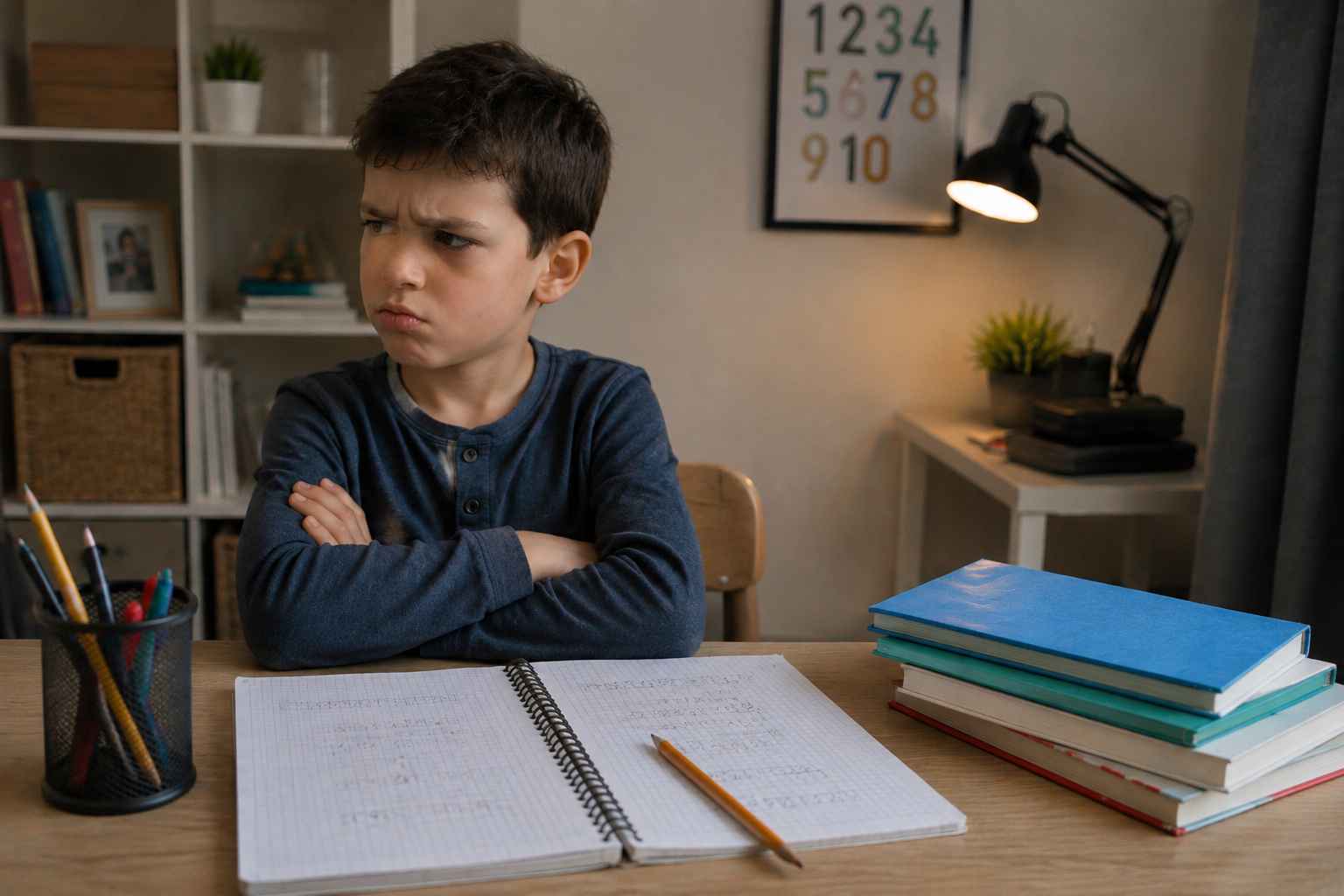
It is 6pm. The math homework is on the table. Your child is under the table, announcing that they hate math and are never doing it again.
That refusal does not tell you whether your child can learn math. It tells you how math feels to them right now.
The goal is to change that experience without turning every evening into a fight.
This guide covers what to do tonight, what to change over the next month, and how to rebuild the skills and confidence your child needs to succeed.
First, What “I Hate Math” Usually Means
When children say they hate math, they are often reacting to what the subject makes them feel.
- “I do not understand this.”
- “I feel stupid when I get it wrong.”
- “Everyone else seems faster than me.”
- “I am afraid of failing again.”
Refusing to try can become a form of self-protection. If a child does not attempt the problem, they do not have to experience another wrong answer.
That is why resistance is usually more useful as information than as evidence of laziness or defiance. The important question is not simply why your child will not do the work.
It is where the learning became difficult enough that avoiding math started to feel safer than attempting it.
View this post on Instagram
Math Anxiety Is Real
Math anxiety can cause physical and cognitive symptoms, including a racing heart, stomach discomfort, panic, and the feeling that the mind has suddenly gone blank.
The reason is that anxiety consumes working memory, the mental space children use to hold numbers, steps, and intermediate answers while solving a problem.
A child may know a fact in a relaxed setting and still struggle to retrieve it during a test or stressful homework session.
Research estimates vary considerably, so broad claims about exactly how many people experience math anxiety should be treated cautiously. The more useful point is that it is common among both children and adults.
Recognising anxiety changes the response. Instead of treating the meltdown as a behaviour problem, you can start looking for the source of the fear.
Why your child refuses to do math
Most resistance comes from a small number of underlying problems.
Missing Building Blocks
Math is cumulative. New concepts depend heavily on earlier ones.
A child who never became comfortable with multiplication facts may struggle with division. Weak place-value skills can make multi-digit addition and subtraction confusing.
Fractions become much harder when multiplication and division are still slow or uncertain.
- Counting and number sense support addition and subtraction.
- Place value supports multi-digit arithmetic.
- Multiplication facts support division, fractions, and later algebra.
- Fraction understanding supports ratios, percentages, and proportions.
When one of these foundations is weak, the current lesson can feel impossible even when the real problem began much earlier.
Fear of the Wrong Answer
Some children interpret mistakes as evidence that they are “bad at math.”
Once that belief takes hold, refusing to try can feel safer than risking another failure. A child may even prefer the consequence of unfinished homework to the embarrassment of writing down an answer that might be wrong.
The solution is not simply more practice. The child also needs to experience mistakes as a normal part of learning rather than a judgement of ability.
Math Feels Pointless
“When will I ever use this?” is often a reasonable question.
If math exists only as worksheets and tests, motivation can disappear quickly. Children understand abstract concepts more easily when they can connect them to something familiar.
Cooking, shopping, games, money, sports statistics, building projects, and measuring objects can all give numbers a purpose.
Homework Has Become a Power Struggle
Sometimes the original math difficulty is no longer the main problem.
If homework has become a nightly argument, both parent and child may enter the routine expecting conflict. At that point, refusing the worksheet can become partly about control.
You have to reduce the conflict before the academic problem can be addressed effectively.
What to do Tonight – End the Standoff First
View this post on Instagram
You cannot teach much while a child is crying, panicking, or locked into an argument.
Tonight’s goal is not necessarily to finish every problem. It is to make learning possible again.
Stop Fighting and Start Problem-Solving
Step out of the role of opponent.
Sit beside your child rather than across from them and treat the difficult problem as something you are examining together.
Instead of saying, “why won’t you just do it?”, try: “Show me the part that feels confusing.”
That small shift helps move the conversation from obedience to problem-solving.
Make the Assignment Look Smaller
A page full of problems can feel overwhelming before the child has attempted the first one.
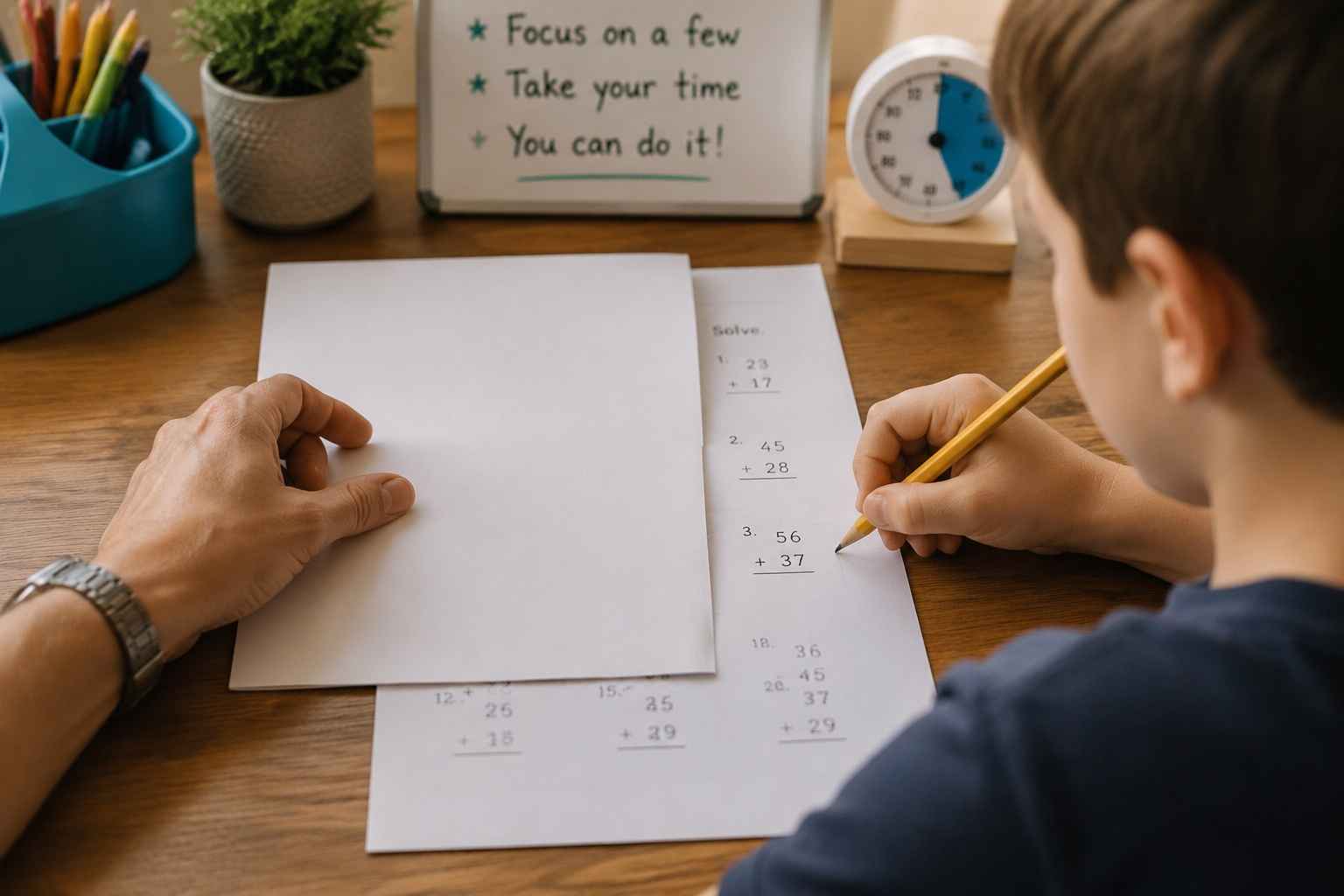
Cover part of the worksheet or focus on a small group of questions at a time. Completing a manageable section creates an immediate success and makes the next section feel less threatening.
Work in Short Bursts
Set a short, clear work period and stop when it ends.
For many children, ten focused minutes followed by a genuine break is more productive than an hour of arguing, staring at the page, and forcing increasingly careless answers.
Short sessions are especially useful for younger children or anyone whose concentration drops sharply once frustration begins.
Take Breaks Before Frustration Peaks
If your child is becoming increasingly upset, continuing usually makes learning worse.
- Get a drink of water.
- Walk around for a few minutes.
- Stretch or move.
- Sit somewhere different.
Return once the child is calm enough to think again.
A break should help regulate attention, not become a bargaining chip or punishment.
Ask Questions That Locate the Problem
Avoid general questions such as “Why are you being difficult?”
- “Which question first stopped making sense?”
- “Can you show me what you tried?”
- “What part do you understand?”
- “What do you think the first step is?”
Children often reveal the missing skill quickly when the conversation becomes specific.
What to do this Month – Rebuild the Math Concepts Underneath
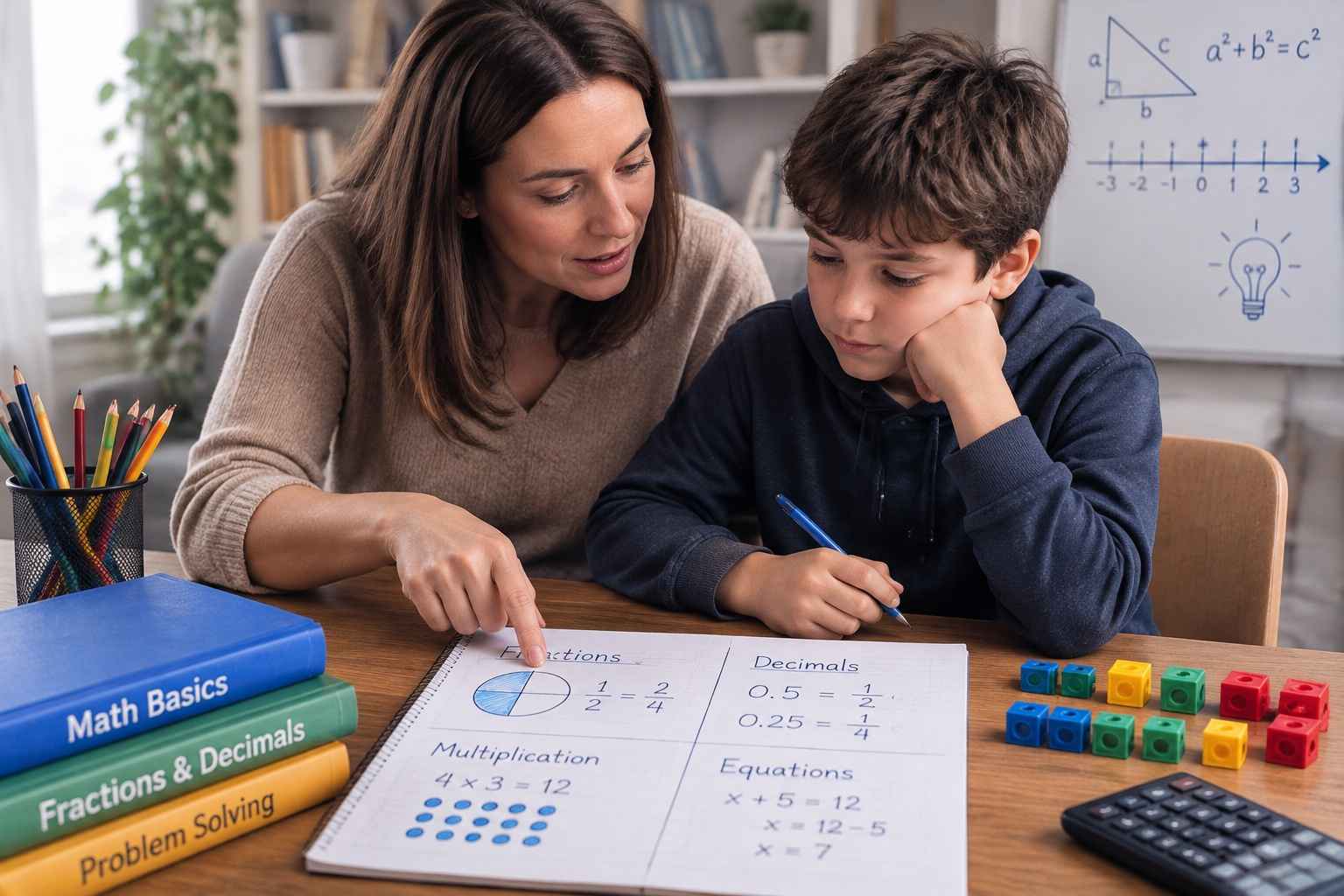
Once homework is calmer, the next task is to identify what your child actually needs to relearn.
Identify the Skill Gap
Work backward from the current problem.
If long division is difficult, check multiplication facts. If multi-digit subtraction is falling apart, look at place value and regrouping. If fractions are confusing, test whether multiplication, division, and the meaning of numerator and denominator are secure.
You are looking for the point where confident work turns into guessing.
A short, low-pressure check of earlier material is often more useful than another full worksheet at the current level.
Return to the Right Starting Point
If the missing skill is from an earlier grade, teach that skill first.
This can feel like moving backward, but it often produces faster progress. A child cannot reliably learn the next procedure while the prerequisite skill remains unstable.
Temporarily practising easier material is not lowering expectations. It is strengthening the foundation required to meet them.
Praise the Behaviours That Lead to Learning
If praise appears only after a correct answer, children can begin to treat correctness as the only thing that matters.
- Trying a second method.
- Checking an answer.
- Asking a useful question.
- Continuing after a mistake.
- Explaining the reasoning clearly.
“I liked that you tried again after getting stuck” teaches something very different from “Good, you got it right.”
Confidence grows from repeated experiences of being able to struggle, adjust, and eventually succeed.
When Your Child Hates Math, Change What Practice Feels Like
@themathymama 🙃I used to add this mentally by stacking the numbers and carrying the one! It was how I was taught and I never thought to try anything different. The same goes for subtracting and multiplying – I just tried to visualize what I would have written on paper – and it’s so hard to keep track of all of those numbers! ✨ When I finally realized there were other ways to visualize these problems, that’s when my real life began. Ok, maybe it wasn’t that dramatic, but I got a lot faster at mental math!! 👀 I know these problems LOOK like we are asking our kids to do so much more work than is “needed” to solve the problem, but we are equipping them with the tools to be able to add, subtract, and multiply in their heads. We also want to teach them to be flexible with their thinking – for any problem, which method would be easiest and work well for them? If you’ve never learned math this way, I encourage you to give it a shot and see if it changes the way that you think about numbers! 👉🏼 Follow along for help with elementary math topics! Hi, I’m Justina, math teacher and mom of three. 🌟 I want to help you understand the new math methods so you can help your kids with their homework! #addition #thirdgrade #homeworkhelp #mathtok #learnontiktok ♬ original sound – MathyMama
A child who refuses worksheets may willingly practise the same underlying skills in a game.
That does not make games magically better than formal instruction. It means the emotional context is different. Games can reduce the feeling of being tested and make repetition easier to tolerate.
The most useful math games require the child to use the target skill as part of the activity rather than adding an unrelated quiz between entertaining sections.
A Game Where Kids Learn Math by Playing
The best math games hide the drill inside a story or a goal, so the child is practising without feeling tested. Not all games manage it, so look for games where the math is unavoidable rather than bolted on.
MathHero is built on exactly this idea. It is a story-driven adventure for kids ages 5 to 10, where the way you move the story forward, rescuing characters, earning coins, unlocking gear, is by solving short sets of math facts.
The math is the mission, not a toll booth between the fun parts, which is what keeps a reluctant child coming back to it.
For a child who refuses to do math, two things about it matter.
You decide what your child practises: addition and subtraction within 10, 20, 100 or 1000, times tables, or division, and you can set the difficulty level or switch on a guided step-by-step path.
Teach Math Through Real Life
Not all practice needs to happen on a screen or worksheet.
Everyday activities create natural reasons to use numbers.
- Cooking introduces fractions, measurement, multiplication, and ratios.
- Shopping uses addition, subtraction, estimation, and percentages.
- Card games can practise number comparison, addition, or multiplication.
- Sports statistics can introduce averages, percentages, and probability.
- Building and craft projects use measurement, geometry, and spatial reasoning.
The advantage is not simply that these activities are more entertaining. They show the child what the mathematics is for.
Keep Some Practice on Paper
Play should not replace every traditional method.
Children still need experience writing calculations, showing their work, reading notation, and solving problems in the format they will encounter at school.
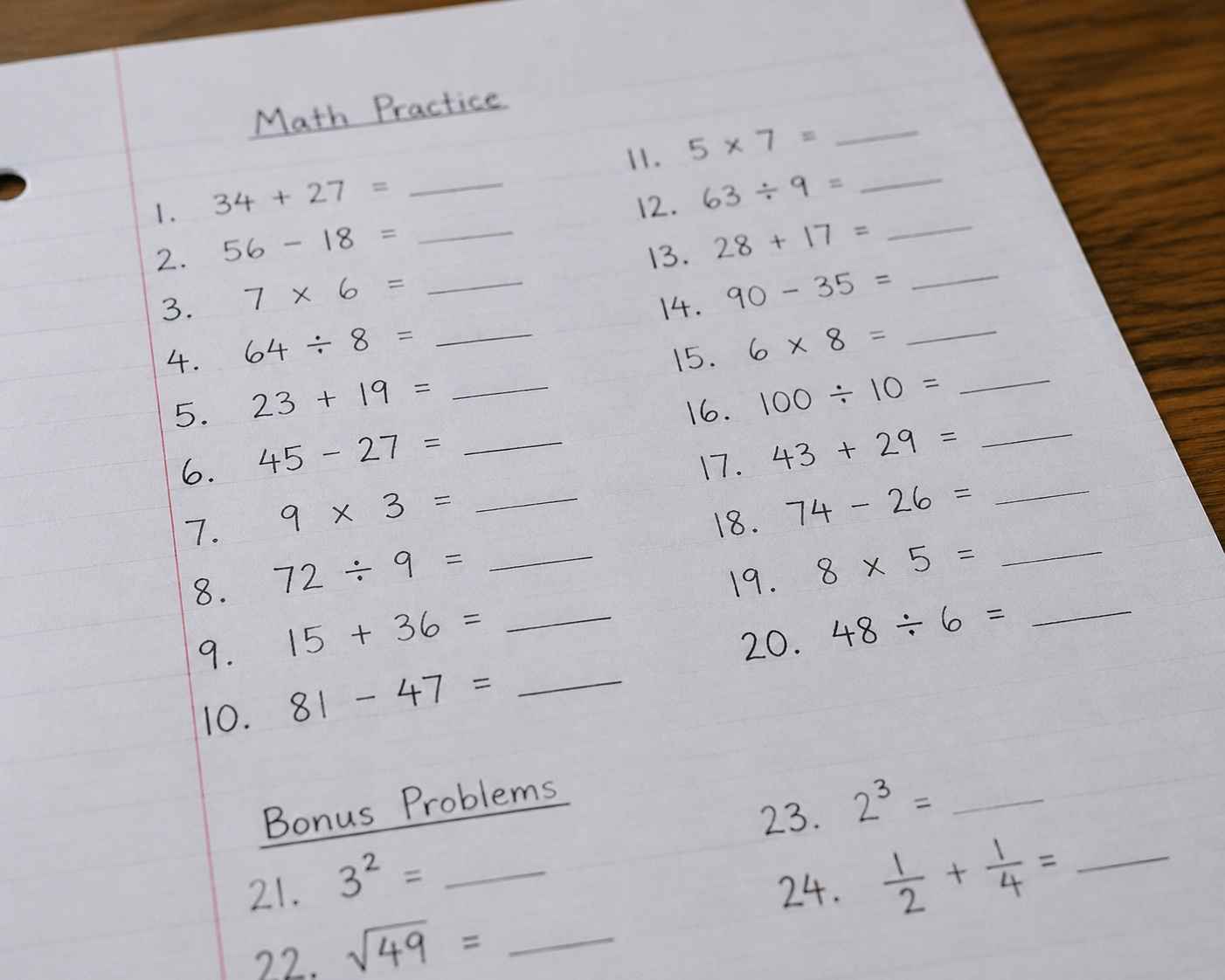
Flashcards, short worksheets, handwritten facts, and textbook exercises can still be useful when they are targeted and brief.
When to Bring In Outside Help
Home strategies are not always enough. If the problem continues despite calmer routines and targeted practice, additional support can help identify what you are missing.
Talk to the Math Teacher
The teacher should usually be the first person you contact.
Ask what they are seeing in class and whether the difficulty appears to involve the current topic or an older skill.
- “Where do you notice them getting stuck?”
- “Which prerequisite skills should we check?”
- “Is this difficulty showing up in class as well as at home?”
- “What should we practise first?”
A focused conversation can prevent you from spending weeks practising the wrong thing.
Consider a Tutor for Persistent Gaps
A good tutor can give your child something that is difficult to provide in a busy classroom: sustained attention to one specific misunderstanding.
The most useful tutoring is targeted. It should identify the missing skill, teach it in a different way if necessary, and check that the child can use it independently before moving on.
More worksheets alone are not the point.
Watch for Signs That the Difficulty Is Broader
If basic number skills remain unusually difficult despite consistent teaching and practice, consider asking whether your child should be evaluated for a learning difference such as dyscalculia.
- Number sense.
- Basic arithmetic.
- Comparing quantities.
- Remembering number facts.
- Telling time.
- Understanding numerical sequences.
These signs do not confirm dyscalculia on their own. Teachers, a pediatrician, educational specialists, or a school psychologist can advise you about appropriate assessment.
Your Own Attitude Matters
Children notice how adults talk about math.
Comments such as “I was never a math person either” may sound harmless, but they can reinforce the idea that mathematical ability is fixed and inherited.
You do not need to pretend that math is easy or that you love every part of it. Model a more useful response to difficulty.
Replace “I am terrible at this” with something like, “I do not remember how to do this yet. Let’s work it out.”
The message your child needs is simple: being stuck is a temporary state, not an identity.
The Bottom Line
A child who refuses to do math is telling you that something about the experience has become difficult, frightening, confusing, or exhausting.
Start by locating the cause rather than escalating the pressure. Calm the homework routine, identify missing skills, return to the right level, and vary the way your child practises.
When the fear drops and the foundations improve, resistance often drops with them.